 Home Advisor Locksmith
Locksmith Guidance for Opa locka Tenants and Businesses
Shared buildings, small shops and work vehicles create lock problems that homes alone do not. This general guide for Opa locka explains key control, rekeying, lockouts and when to call, with Miami Dade climate in mind.
How to use this general guide
This page is general guidance for people in and around Opa locka. It does not describe particular streets, buildings or landmarks, and it does not claim that the company has worked at any specific address. What it offers is a practical way of thinking about locks for people who share space with others: tenants in multifamily buildings, owners of small shops, and anyone who drives a vehicle that several people use.
Home Advisor Locksmith is a mobile, locally owned locksmith serving every ZIP in Miami Dade. A real person answers the call, the price is explained before the truck rolls, and the technician comes to you. When the work is done, it is checked with you before the visit closes. Contact is by phone, so you can describe your situation in your own words and ask questions as they come up.
Read the sections that match your situation. A property manager will care most about key control and turnover. A shop owner will care about storefront doors and after hours entry. A driver will want the vehicle sections. Everyone benefits from the final section about testing the work, because a lock that looks fixed is not the same as a lock that has been proven to work.
Multifamily buildings: lock questions for tenants and managers
In a building with many units, locks sit in layers. The outer entrance, the mail area, the laundry room and the individual apartment doors may each belong to a different party. A tenant usually has authority over nothing beyond a personal unit, and sometimes not even that, since many leases forbid changing a lock without permission. The first step in any lock problem is to know which layer is involved.
Tenants should check the lease and then ask the landlord or the property manager. If you are locked out of your unit, a locksmith will want proof that you live there, and the manager can sometimes confirm that for you. If your key was lost or stolen, say so right away, because the unit may need to be rekeyed for the safety of everyone who lives nearby, and the manager will want to coordinate.
Managers face a different set of questions. Who holds the master key, how is tenant turnover handled, and what happens when someone claims to have lost a key? Our page on locksmith work for apartment complexes outlines the typical services, and the property manager page covers the larger picture of keeping many doors organized.
Small shops and storefronts after hours
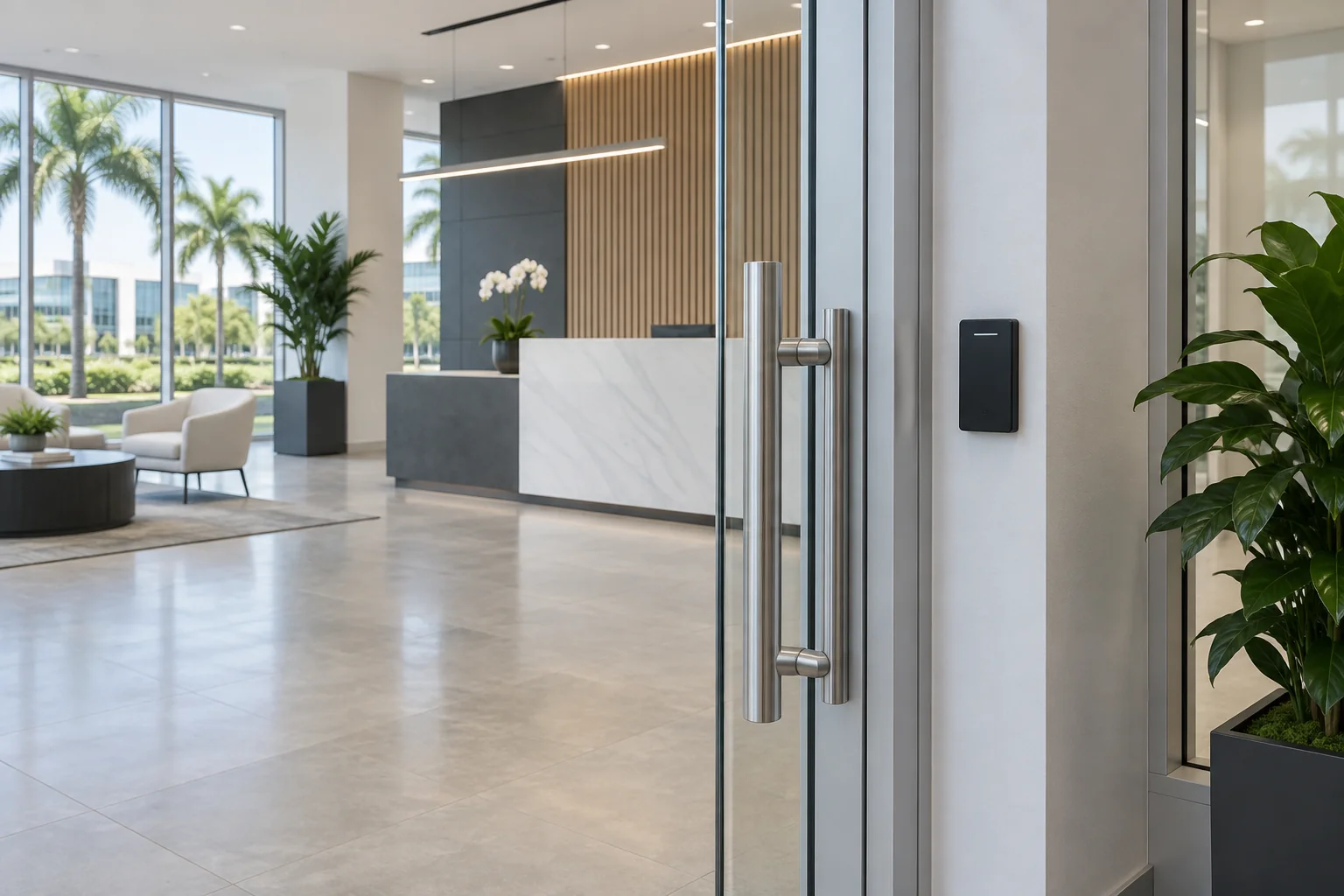
A storefront has a particular weakness: much of its front is glass. Whatever lock is on the door is only part of the protection, and the door frame, the hinges and the glass all matter. Many glass doors use a narrow metal frame with a lock set into a thin stile, which limits what hardware fits. A locksmith who works on storefronts can tell you plainly what your door can support.
Think about how the shop opens and closes. Who locks up, who has the keys, and what happens if the person responsible is sick or on vacation? A key hidden under a mat or kept in a predictable spot defeats the purpose of having a lock. Better to have a short list of trusted people, each with their own key, and a clear note of who they are.
Humidity and salt in the air matter at a storefront too. A door that opens and closes hundreds of times a day wears its hinges and latch down, and damp air speeds corrosion on exposed metal. A door closer that is set too weakly may let the door rest ajar, which a passerby could mistake for a door that is not locked at all. Test the closing action at the start of each day.
Our page on storefront and glass door locks explains the hardware used on these doors, from hook bolts to pivot locks. If you manage several tenants, the same logic applies to common doors. And if you own a retail business, the page on locksmith work for retail shops adds context about customer flow, back rooms and stock security.
Key control: the habit that saves the most trouble
Key control sounds technical, but it comes down to knowing who has a key and being able to take that access away. A business with perfect key control can answer three questions at any time: how many keys exist, who holds each one, and which doors does each open. Most small operations cannot answer even one of those, and that is the root of many security headaches.
Start simply. Write a list of every key, with the date it was issued and the name of the holder. Never stamp a business name or address on the key. Do not let employees make their own copies, and consider using a restricted keyway for important doors, since those keys cannot be copied at a typical hardware store without authorization.
When someone leaves, the options are to collect the key and hope no copy exists, or to rekey. If your list is incomplete, rekeying is the only way to be sure. Our guide to a business key control policy offers a framework you can adapt, and a master key arrangement can give managers broad access while keeping staff access limited to their own areas.
A word about how master key systems work, since they come up often. Each lock has its own change key, and a higher level key is cut to open many locks. The design adds convenience, but it also adds extra pin positions inside each cylinder, so it needs careful planning and clear records. A poorly planned system can create keys that open doors by accident. Ask the technician to sketch the plan on paper before work begins, and keep that sketch in a safe place.
- Keep a written key list with holder names and issue dates.
- Avoid stamping the business name or address on any key.
- Use restricted keys for important doors so copies need authorization.
- Rekey after any key loss that cannot be fully accounted for.
Apartment turnover and the unknown key problem
When one tenant leaves and another arrives, the old tenant's keys do not vanish. They may be in a drawer, with a relative, with a former roommate or in a car glove box. A unit that has not been rekeyed between tenants carries the risk that a former resident can still enter, whether on purpose or by accident, and the next tenant has no way of knowing.
Rekeying between tenants is a straightforward routine. The technician changes the pins inside each cylinder so that the old keys no longer work, and the new tenant receives fresh keys. Because the hardware stays in place, the process is gentler on the door and on the budget than replacing every lock. Managers who do this consistently also avoid arguments about who was responsible for a problem.
For the practical details, our page on apartment turnover lock changes explains what is typically done. Tenants who move into a place should ask whether it was rekeyed, and if there is any doubt, ask the manager to arrange it. In a private rental or a family owned building, the same idea applies even if no formal process exists.
Keep an eye on the less obvious entries during turnover. Mailbox locks, storage closet locks, gate fobs, laundry room keys and balcony door latches are often forgotten, and they carry the same risk as the front door. A short checklist for each unit, signed off when the work is done, keeps those details from slipping, and it gives the next manager a record to build on.
Vehicles, work vans and spare keys
A car or a work van is both a tool and a target. Several people may drive the same vehicle, and keys travel between pockets, jobs and homes. When a key is lost, the owner often does not know who last handled it, and the question of whether to treat the vehicle as compromised arrives alongside the question of how to get another key.
Modern vehicle keys frequently contain a transponder chip, which means a replacement must be cut and programmed. If every key is gone, the process can take more steps than a simple copy, and proof of ownership is required. Have your registration or title ready, along with identification. A business that owns several vehicles should keep a record of which keys belong to which vehicle.
Think also about where keys live when nobody is driving. A hook by the office door, visible to anyone who walks in, is convenient and risky at the same time. A locked cabinet with a sign out sheet is dull but effective, and it answers the question of who had the van last when a problem appears. If a vehicle is shared among employees, collect the keys at the end of each shift as a matter of routine. Spare keys are the simplest protection against disruption. A spare made while you still have a working key is much easier than a replacement made after the last one disappears. Read the page on car key replacement to see how the service works. And if a child or a pet is locked inside a hot vehicle, call emergency services before anything else.
Locked out while carrying the day's errands
Lockouts rarely occur at convenient times. They happen at the end of a shift, in the middle of a delivery, or when a door swings shut with the keys on the other side. In a multiunit building, a lockout can also mean the building entrance rather than your own door, and that changes who needs to be involved.
When you call, say where you are and what you are locked out of. Mention whether you can see your keys, whether the door is a standard residential door or a commercial door, and whether anyone else is inside. Be ready to explain your connection to the space. The technician will ask for identification before opening anything, and that routine protects the people who live and work nearby.
If you lock yourself out regularly, treat it as a design problem rather than a personal flaw. A keypad deadbolt, a spare kept with a trusted neighbor or a lockbox inside a secure area can remove the problem. Our guide on what to do when you are locked out lists steps that help in the first minutes, before the technician is on the way.
Emergency visit or scheduled work: choosing the right moment
Some lock problems cannot wait, and others only feel urgent. A lockout with nowhere safe to wait, a door that will not close after a break in, or a key broken off in a building entrance are urgent. A rekey for a unit that is not yet occupied, a hardware upgrade or a master key plan can be scheduled at a calmer pace.
Scheduled work usually gives you more choices. You can compare options, gather the right parts, coordinate with a manager and make sure that everyone who needs a key is present. Emergency work leaves less room for planning, but a calm call still helps. Describe the situation clearly and the dispatcher can explain the price before the truck rolls.
Our comparison of an emergency visit and scheduled lock work sets out the differences. One practical idea is to turn a recent emergency into a scheduled follow up. If a lockout revealed that you have only one key, schedule time to make spares. If a break in damaged a door, schedule an assessment of every other entrance as well.
Security upgrades worth thinking about after a scare
After a break in attempt or a close call, people often want to do everything at once. A calmer approach is to look at the weakest points first. Check the door frame, the strike plate and the length of the screws that hold it. A deadbolt with a short bolt in a loose frame offers less protection than its price suggests.
Consider lighting, visibility and habits too, since a lock is only one layer. A well lit entrance, a clear view of the door from inside, and the practice of locking up even when you are only stepping out all contribute. For businesses, a documented opening and closing routine reduces mistakes and makes unusual events easier to notice.
If you want a professional look at the whole picture, the lock security assessment page describes a walkthrough of your doors. Afterward, the technician can suggest changes in order of importance so you can spread the work over time. Nearby general guides such as Medley and Miami Gardens may help if you operate across several places.
After the work: testing and notes
Before the technician leaves, test everything. Use each key in each lock several times, lock and unlock from both sides, and open and close the door with a normal amount of force. Check that the latch catches and the bolt extends fully into the frame. Listen for grinding or rattling. If you notice something wrong, say so then, not later.
Keep records. Write down which locks were changed or rekeyed, how many keys exist, and who holds them. If a code was set on a keypad, record who received it. A short note kept in a safe place saves confusion months later, when somebody wonders why a key no longer works or whether a particular door was included in the last job.
Photographs help here too. A picture of the finished hardware, the door edge and the keys laid out together takes seconds and gives you something to compare if a problem returns. Finally, plan the next small step. Make spares from a working key before it fails. Schedule seasonal checks before the wet months. And when you hire help, use the page on understanding a locksmith estimate to confirm what a price includes, so there are no surprises when the invoice arrives.
Common questions
Can a tenant change the locks on a rented unit?
Not necessarily. Many leases require permission, and some landlords handle lock changes themselves. Check your lease and ask the landlord or manager before booking any work. If the manager agrees, tell the technician and ask whether a copy of the key is needed for the building. Written permission prevents disputes later.
How often should a business rekey its locks?
There is no fixed schedule. Rekey whenever you cannot account for every key, when a staff member with access leaves, or when you move into a space with an unknown history. A written key list makes the decision much easier, because gaps in the list tell you when rekeying is the safer course.
What is a restricted keyway and why would I want one?
A restricted keyway uses a key blank that is controlled by the manufacturer, so copies generally require authorization instead of a simple trip to a hardware counter. It helps businesses and managers control who can duplicate keys. It adds some cost and process, so it suits important doors more than a rarely used closet.
What proof will I need if I am locked out of my unit?
Expect to show identification and something linking you to the unit, such as a lease, a utility bill or mail with your name. A building manager may also confirm your tenancy. The check exists to protect residents from strangers. If you lack paperwork at hand, explain the situation to the dispatcher and ask what alternatives exist.
Why does a new car key sometimes need programming?
Many modern keys contain a transponder chip that the vehicle must recognize before the engine will start. A key that is cut correctly but unprogrammed may open the door and still fail to start the car. Programming pairs the chip with the vehicle, and proof of ownership is part of the process.
Is it better to wait for scheduled work or call right away?
If you are locked out, unsafe or facing a damaged door, call right away. If the issue is an upgrade, a spare key or a plan for turnover, scheduling gives you more options and a calmer conversation. When in doubt, describe your situation on the phone and the dispatcher can help you decide.